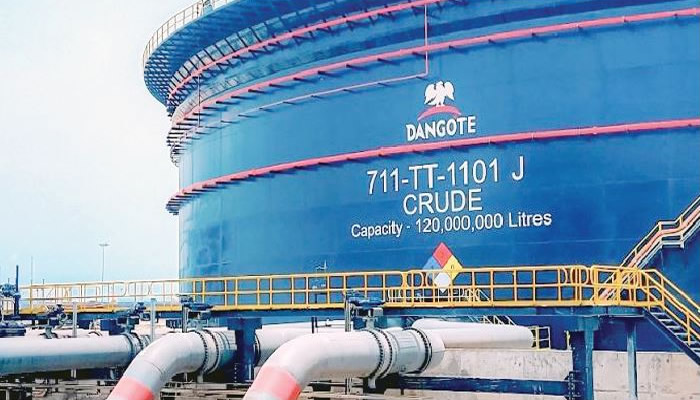
Tag: Dangote refinery

  • Dangote diesel sulphur triggers concern, marketers fault rejection report

    Dangote diesel sulphur triggers concern, marketers fault rejection report

    • Dangote diesel sulphur triggers concern, marketers fault rejection report
    5th August 2024
    DANGOTE REFINERY
    Dangote Refinery
    Okechukwu Nnodim and Dare Olawin

    Kindly share this story:

    The controversy surrounding the sulphur content in the Automotive Gas Oil, popularly called diesel, produced by the Dangote Petroleum Refinery, has yet to abate, The PUNCH reports.

    Over the weekend, there were online reports alleging that the diesel recently supplied by the $20bn refinery contained high sulphur.

    This came as oil marketers stated that despite the allegations of high sulphur in Dangote diesel, no motorist or industrial consumer had registered any complaint against the product.

    “We don’t want to be involved in the politics or claims and counter-claims about Dangote diesel, but what I going to tell you is that no transporter, motorist, or industrial consumer has complained about the diesel since we started distributing it,” the National President of the Independent Petroleum Marketers Association of Nigeria, Abubakar Maigandi, stated.

    Did you know a tribe that digs up corpses, dresses them for celebration?So This Happened (251) reviews the murder of a pregnant woman in Rivers, otherSo This Happened Reviews 17-year-old Nigerian awarded full scholarships, OthersSo This Happened (205) Reviews Matawalle's EFCC Probe, US Embassy Staff Convoy Attack, Other | PunchA top official of the Dangote Group said the recent report on high sulphur content in Dangote diesel emanated from individuals who were hellbent on destroying the refinery, describing the report as fake.

    The PUNCH recalls that the  President of the Dangote Group, Aliko Dangote, and some officials of the company had earlier accused the Nigerian Midstream and Downstream Petroleum Authority of importing dirty fuel into Nigeria.

    While accusing the international oil companies of plans to frustrate the refinery, the Vice President of Oil and Gas at Dangote Industries Limited, Devakumar Edwin, also accused the NMDPRA of granting licences indiscriminately to marketers to import dirty refined products into the country.

    According to Edwin, the Federal Government issued 25 licences for the construction of refineries in Nigeria, but only the Dangote Group delivered on its promise.

    “The Federal Government issued 25 licences to build refineries and we are the only one that delivered on our promise. In effect, we deserve every support from the government. It is good to note that from the start of production, more than 3.5 billion litres, which represents 90 per cent of our production, have been exported. We are calling on the Federal Government and regulators to give us the necessary support to create jobs and prosperity for the nation,” Edwin had stated.

    He alleged that even though Dangote was producing and bringing diesel into the market, complying with the regulations of the Economic Community of West African States, “licences are being issued, in large quantities, to traders who are buying the extremely high sulphur diesel from Russia and dumping it in the Nigerian market.”

    Edwin had lamented, “The decision of the Nigerian Midstream and Downstream Petroleum Regulatory Authority in granting licenses indiscriminately for the importation of dirty diesel and aviation fuel has made the Dangote refinery expand into foreign markets. The refinery has recently exported diesel and aviation fuel to Europe and other parts of the world. The same industry players fought us for crashing the price of diesel and aviation fuel, but our aim, as I have said earlier, is to grow our economy.”

    He argued that because the refinery met the international standard as well as complied with stringent guidelines and regulations to protect the local environment, it had been able to export its products to Europe and other parts of the world.

    “It is regrettable that in Nigeria, import licences are granted despite knowing that we can produce nearly double the amount of products needed in Nigeria and even export the surplus. Since January 2021, ECOWAS regulations have prohibited the import of highly contaminated diesel into the region,” Edwin stated.

    But while the NMDPRA Chief Executive, Farouk Ahmed, was reacting to Dangote, he denied all allegations of sabotage, stating that it was the Dangote diesel that had higher sulphur content than the imported ones.

    Ahmed had revealed that the refinery, which had been selling diesel and aviation fuel in Nigeria for months, had not been licensed, stating that it was still at the pre-commissioning stage with 45 per cent completion.

    The NMDPRA boss warned that Nigeria could not rely heavily on the Dangote refinery for its fuel supply.

    According to him, the refinery had requested the regulator to stop giving import licences to other marketers so as to be the only fuel supplier in Nigeria.

    Speaking about quality, Ahmed alleged, “So, in terms of quality, currently the AGO quality in terms of sulphur is the lowest as far as the West African requirement of 50 ppm is concerned.

    “Dangote refinery and some modular refineries, like Waltersmith refinery and Aradel refinery, are producing between 650 to 1,200ppm (parts per million). So, in terms of quality, their product is much inferior to the imported quality.”

    Reacting during a tour of the refinery by members of the House of Representatives led by the Speaker, Tajudeen Abbas, recently, Dangote asserted that products refined at the world’s largest single train refinery are of superior quality compared to imported equivalents and meet international standards.

    The speaker and other members had observed the testing of Automotive Gas Oil from two petrol stations alongside the same taken from the Dangote refinery.

    The diesel samples were procured from two filling stations near Eleko junction along the Lekki-Epe Expressway, Lagos, by the lawmakers.

    The Dangote laboratory tests were said to have revealed that Dangote’s diesel had a sulphur content of 87.6 ppm while the other two samples showed sulphur levels exceeding 1,800 ppm and 2,000 ppm respectively.

    Speaking, Dangote emphasised that the findings had debunked claims made by Ahmed that imported diesel surpasses domestically refined products.

    “We produce the best diesel in Nigeria. It is disheartening that instead of safeguarding the market, the regulator is undermining it. Our doors are open for the regulator to conduct tests on our products anytime; transparency is paramount to us. It would be beneficial for the regulator to showcase its laboratory to the world so Nigerians can compare. Our interest is Nigeria first because if Nigeria doesn’t grow, we have limited capacity for growth.

    Dangote argued that the imported products being encouraged by Ahmed have failed in tests, saying most of the importers have fake certificates because the owners of the laboratories have been told what to write.

    Speaking about the sulphur content, he added, “I am actually surprised for somebody to come and mention that we have a bad quality; we and other modular refineries. I can’t talk of the quality of the modular refineries, but our own today is 87ppm and by Monday (July 23), we will be at 50ppm, by the beginning of August, we will be at 10ppm.

    “All the test certificates people are busy flaunting around today are fake certificates. The demarketing of a company by a regulator that he is supposed to protect is very very unfortunate. We produce the best diesel in Nigeria and if the regulator wants, he can come any time to conduct a test.”

    During an interview with The PUNCH, the NMDPRA spokesperson, George Ene-Ita told our correspondent that there are about 15 engineers and scientists of the NMDPRA embedded in the refinery whose reports would get to the agency to confirm the current sulphur content of Dangote’s diesel.

    Related News

    The regulator has yet to make known the report from its men since two weeks ago, especially as the comments from the NMDPRA boss were greeted with backlashes.

    However, different laboratory results surfaced online during the weekend, alleging that diesel supplied to retailers between April and July, revealed that the sulphur content in Dangote diesel went up to as high as 1200 ppm.

    The online reports said that the fuel, delivered in 32 batches, was supplied to different depots of Rain Oil, AA Rano, TMDK Oil, Kashton, NIPCO, Sobaz, and other retail companies.

    It was also alleged that two days after the lawmakers’ visit, the Dangote refinery delivered a shipment of diesel containing 950 ppm of sulphur to AA Rano’s depot in Ijegun, Lagos, saying the certificate of quality, dated July 21 was authorised by an independent laboratory name Intertek.

    While reacting to this, an official of the Dangote Group said some individuals were trying to pull down the refinery.

    The official, who pleaded anonymity because he was not authorised to speak with the press, described the report as falsehood.

    “But you should know where this is coming from. It is false,” the official said

    He added further, “They are intentionally circulating the falsehood. They are bent on destroying us. All these are fake documents. They are intentionally circulating it to spoil our good name.”

    The source refused to mention names, saying Nigerians know the faces behind the online report.

    The NMDPRA spokesperson could not be reached at the time of filing this report.

    Dangote refinery, which is supposed to start the sale of petrol in one week, has got the support of President Bola Tinubu, who has ordered the Nigerian National Petroleum Company Limited to sell crude to it in naira.

    CSOs speak

    In a similar development, a coalition of Civil Society Organisations has said it would set up a situation room to monitor the compliance of NNPCL to the presidential directive to sell crude oil to Dangote refinery in naira.

    Leaders of the 28 CSOs who were on a facility tour of the 650,000 bpd world’s largest single train refinery in Lagos said the disposition of NNPC and the regulatory agencies was a clear indication that they deliberately held down the nation’s refineries so that they could continue importing petroleum products.

    Speaking on behalf of others, Solomon Adodo, of the Rise Up for A United Nigeria, said what his group had seen was a world class facility and wondered how a regulatory agency of the government could take sides with importers of petroleum products when a local refinery now produces the petroleum products.

    He said the CSOs have concluded to petition the Presidency on the need to adopt the Dangote refinery as a national asset that should be used to liberate the country from the shackles of importation of fuel while it exports crude.

    In a statement issued on Sunday by the refinery, Adodo said, “Having gone round to see this world class project, we are at a loss as to why the government could decide to turn against Nigerians in this manner. But we are not too surprised given our past experiences. Those who are profiting from our collective misfortune will not want the Dangote refinery to work.

    “We are ready to defend this facility with everything as civil society organizations. We are not speaking on our behalf but on behalf of all Nigerians and on behalf of our fatherland. It leaves much to be desired how an agency of government with oversight function to guide to grow such a project as this would now be disparaging the same project. This is too bad.

    “We have seen for ourselves and we have cleared all doubt as to the completion of this refinery and the readiness to supply all our domestic needs. We will expose them all. Anyone who is not ready to ensure that Nigeria has a new lease of life must give way. Now it is a fight to finish.

    “Going forward, we are going to set up a situation room to monitor the compliance of NNPC with the directive of Mr President that Dangote refinery would be supplied with crude in naira because we know that the enemies of the people would want to adopt another strategy to sabotage the presidential directive.”

    Foreign nations invite Dangote

    Speaking while welcoming the group, Edwin described Dangote refinery as a value adding facility as it would stop the exportation of Nigeria’s crude and importation of finished products and wondered why the government would be against such a vision for Nigeria.

    According to him, many African countries have minerals but they are not adding value to their economies because those minerals are exported raw and the finished products are imported back into the country whereas vice versa should have been the order of the day.

    “This is what Dangote refinery seeks to correct, we did the same in the cement and sugar sectors where Nigeria was a leading importer of those products, and with the coming of Dangote leading the backward integration programme of the government, others came into the sector and together Nigeria now exports cement to other countries.

    “What we want to do in the refinery, we have done it in other businesses, Nigeria used to be the biggest importer of sugar, we came in and changed the narrative. We led the backward integration scheme of the Federal Government, and we now produce sugar locally for domestic consumption and others have joined us. We did the same in cement by opening up the production plant and today Nigeria exports cement to other countries,” he stated.

    On crude supply challenges, the Dangote official said, “We didn’t ask for any favour other than that we want to buy crude to produce. First they said there was no crude, later they said we would have to pay some dollars above the prevailing crude market price. And this is a global market where you can track crude prices anytime. We resorted to buying crude from Brazil and the United States. Later they said we should not be announcing the price of the products.

    “Even the US, the leading proponent of a free market economy, protects its local industries by imposing huge duties on from foreign imports just to protect local industries. This is a man that Saudi Aramco once approached to come and cite his refinery in Saudi Arabia, promising steady supply of crude. Abu Dahbi also invited him to do the same on their soil but he rejected it, insisting he would build at home. Now he did that, a facility that is supposed to add value to Nigeria’s economy is being frustrated.”

    According to him, Nigeria can only consume 45 per cent of the capacity of the refinery while the remaining 55 per cent will be exported and will bring foreign exchange into the country.

     

  • Inferior fuel: FG demands Dangote refinery’s diesel report, orders new test

    Inferior fuel: FG demands Dangote refinery’s diesel report, orders new test

    The Federal Government, through the Nigerian Midstream and Downstream Petroleum Regulatory Authority, is expecting fresh reports to confirm the real sulphur content of the diesel produced by the Dangote refinery as the company debunked claims of inferior fuel production.


    The NMDPRA spokesman, George Ene-Ita, in an interview with The PUNCH on Sunday, said the agency had done its job and would not engage in a media fight with anybody over the claims made by the NMDPRA Chief Executive, Farouk Ahmed, that Dangote’s diesel has more sulphur content than imported one.

    According to Ene-Ita, the authority has about 15 engineers and scientists embedded in the Dangote refinery, whose fresh report about the refinery’s sulphur content will be out on Monday (today).


    The PUNCH reported Ahmed as alleging that the diesel from the Dangote refinery contains high sulphur content.

    Reacting to Dangote’s allegations that the NMDPRA was giving licences to some traders to import dirty fuel into Nigeria last week, Ahmed argued that it was the Dangote fuel that had a larger content of sulphur.


    He also said the refinery, which has been selling diesel and aviation fuel in Nigeria for months, had yet to be licensed, stating that it was still at the pre-commissioning stage.

    The claim by some media houses that there were steps to scuttle the Dangote refinery is not so. The Dangote refinery is still in the pre-commissioning stage. It has not been licensed yet; we haven’t licensed them yet. They are still in the pre-commissioning. I think they have about 45 per cent completion,” Ahmed declared.

    The NMDPRA boss warned that Nigeria could not rely heavily on the Dangote refinery for its fuel supply.


    According to him, the refinery had requested the regulator to stop giving import licences to other marketers so as to be the only fuel supplier in Nigeria

    Nigeria.


    “We cannot rely heavily on one refinery to feed the nation, because Dangote is requesting that we should suspend or stop importation of all petroleum products, especially AGO and direct all marketers to the refinery, that is not good for the nation in terms of energy security. And that is not good for the market, because of monopoly,” he stressed.

    Speaking about quality, he said, “So, in terms of quality, currently the AGO quality in terms of sulphur is the lowest as far as the West African requirement of 50 ppm is concerned.


    “Dangote refinery and some modular refineries, like Waltersmith refinery and Aradel refinery, they are producing between 650 to 1,200ppm. So, in terms of quality, their product is much more inferior to the imported quality,” he alleged.

    Reacting during a tour of the refinery by members of the House of Representatives led by the Speaker, Hon. Tajudeen Abbas, over the weekend, Dangote asserted that products refined at the world’s largest single train refinery are of superior quality compared to the imported fuel.


    The speaker and other members had observed the testing of Automotive Gas Oil from two petrol stations alongside the same taken from the Dangote refinery.

    The diesel samples were procured from two well-known filling stations near Eleko junction along the Lekki-Epe Expressway, Lagos, by the lawmakers.


    The Chairman of the House Committee on Downstream, Ikeagwunon Ugochinyere, and Chairman of the House Committee on Midstream, Okojie Odianosen, oversaw the collection of samples from the Mild Hydro Cracking unit of the Dangote refinery for testing of all the samples.


    The Dangote laboratory tests were said to have revealed that Dangote’s diesel had a sulphur content of 87.6 ppm while the other two samples showed sulphur levels exceeding 1,800 ppm and 2,000 ppm respectively.

    are over 15 engineers and scientists of the NMDPRA working with them for the last how many months. That’s how we get our reports. We have engineers and scientists there, who go there. That’s how we get them. That is why I keep on saying we don’t want to personalise this matter. We are working to see that the local refining capacity is booted to a point where we are self-sufficient in producing our fuel here.”


    Dangote imports crude


    Meanwhile, the Dangote refinery is in talks with Libya to secure crude for the 650,000 barrels per day plant and will also seek Angolan oil, a senior executive, Devakumar Edwin, told Reuters, as the refinery seeks to overcome problems with domestic crude supplies.


    Since Dangote began operations in January, it has been unable to get adequate crude supplies in Nigeria, which, although Africa’s biggest oil producer, is struggling with theft, pipeline vandalism and low investment.


    Dangote has resorted to importing crude from as far as Brazil and the United States.


    “We are talking to Libya about importing crude,” Edwin told Reuters late on Saturday. “We will talk to Angola as well and some other countries in Africa.”


    He declined to give details about the talks but said international traders and oil companies were among the biggest buyers of Dangote’s gasoil, much of which was being exported.


    “The biggest off-takers are the two big traders Trafigura and Vitol and BP and, to some extent, even TotalEnergies. But all of them are saying they are taking it to offshore,” Edwin said.


    Traders and shipping data have shown that Dangote is increasing gasoil exports to West Africa, taking market share from European refiners.


    Dangote has said the refinery will begin the sale of Premium Motor Spirit in August, with a plan to stop the importation of refined fuel into Nigeria.


    Marketers worried


    However, Nigerians and marketers have been expressing concern over the ongoing controversies, especially after the regulator said the country would continue to import refined petroleum products into Nigeria.


    The PUNCH recalls that while accusing the IOCs of plans to frustrate the refinery, the Vice President of Oil and Gas at Dangote Industries Limited, Edwin also accused the NMDPRA of granting licences indiscriminately to marketers to import dirty refined products into the country.


    According to Edwin, the Federal Government issued 25 licences for the construction of refineries in Nigeria, but only the Dangote Group delivered on its promise.


    The vice president noted that more than 3.5 billion litres of diesel and aviation fuel had been exported to Europe by the refinery in the past few months. The exported fuel, it was said, represented about 90 per cent of its production.


    “The Federal Government issued 25 licences to build refineries and we are the only one that delivered on our promise. In effect, we deserve every support from the government. It is good to note that from the start of production, more than 3.5 billion litres, which represents 90 per cent of our production, have been exported. We are calling on the Federal Government and regulators to give us the necessary support to create jobs and prosperity for the nation,” Edwin stated.


    It was alleged that even though Dangote was producing and bringing diesel into the market, complying with the regulations of the Economic Community of West African States, “licences are being issued, in large quantities, to traders who are buying the extremely high sulphur diesel from Russia and dumping it in the Nigerian market.”


    Edwin lamented, “The decision of the Nigerian Midstream and Downstream Petroleum Regulatory Authority in granting licenses indiscriminately for the importation of dirty diesel and aviation fuel has made the Dangote refinery expand into foreign markets. The refinery has recently exported diesel and aviation fuel to Europe and other parts of the world. The same industry players fought us for crashing the price of diesel and aviation fuel, but our aim, as I have said earlier, is to grow our economy.”


    He noted that because the refinery meets the international standard as well as complies with stringent guidelines and regulations to protect the local environment, it has been able to export its products to Europe and other parts of the world.


    “It is regrettable that in Nigeria, import licences are granted despite knowing that we can produce nearly double the amount of products needed in Nigeria and even export the surplus. Since January 2021, ECOWAS regulations have prohibited the import of highly contaminated diesel into the region,” Edwin stated.


    Meanwhile, some Nigerians online have called on President Bola Tinubu to relieve the NMDPRA chief executive of his job for saying the fuels produced by local refineries are inferior to imported ones.


    Also, the House of Representatives said the allegations would be investigated.

  • Crude Shortage: IOCs still causing crude supply crisis, Dangote refinery cries out

    Crude Shortage: IOCs still causing crude supply crisis, Dangote refinery cries out

    Crude Shortage: IOCs still causing crude supply crisis, Dangote refinery cries out.

    The Management of Dangote Industries Limited has insisted that the international oil companies are still frustrating crude supply to its 650,000-capacity refinery.

    The management said this even as it commended the Nigerian Upstream Petroleum Regulatory Commission for its various interventions in the oil company’s crude supply requests from IOCs, and for publishing the Domestic Crude Supply Obligation guidelines to enshrine transparency in the oil industry.


    In a statement on Wednesday, the Dangote Group alleged that the IOCs insisted on selling crude oil to its refinery through their foreign agents, saying the local price of crude would continue to increase because the trading arms offer cargoes at $2 to $4 per barrel, above NUPRC official price.


    In a statement on Wednesday, the Dangote Group alleged that the IOCs insisted on selling crude oil to its refinery through their foreign agents, saying the local price of crude would continue to increase because the trading arms offer cargoes at $2 to $4 per barrel, above NUPRC official price.


    The group also alleged that the foreign oil producers seemed to be prioritising Asian countries in selling the crude they produced in Nigeria.


    The Vice President, Oil & Gas, Dangote Industries Limited, Mr DVG Edwin, said, “If the Domestic Crude Supply Obligation guidelines are diligently implemented, this will ensure that we deal directly with the companies producing the crude oil in Nigeria as stipulated by the Petroleum Industry Act.”

    Edwin insisted that IOCs operating in Nigeria had consistently frustrated the company’s requests for locally-produced crude as feedstock for its refining process.

    He stated that when cargoes were offered to the oil company by the trading arms, it was sometimes at a $2 to $4 (per barrel) premium above the official price set by the NUPRC.


    “As an example, we paid $96.23 per barrel for a cargo of Bonga crude grade in April (excluding transport). The price consisted of a $90.15 dated Brent price plus a $5.08 NNPC premium plus a $1 trader premium. In the same month, we were able to buy WTI at a dated Brent price of $90.15 + $0.93 trader premium including transport. When the Nigerian National Petroleum Company Limited subsequently lowered its premium based on market feedback that it was too high, some traders then started asking us for a premium of up to $4m over and above the NSP for a cargo of Bonny Light.

    Data on platforms like Platts and Argus shows that the price offered to us is way higher than the market prices tracked by these platforms. We recently had to escalate this to NUPRC,” Edwin said, urging the commission to take a second look at the issue of pricing.


    Edwin was reacting to a statement by the Chief Executive of the NUPRC, Gbenga Komolafe, who in an interview on national television said, “It is ‘erroneous’ for one to say that the International Oil Companies are refusing to make crude oil available to domestic refiners, as the Petroleum Industry Act has a stipulation that calls for a willing-buyer, willing-seller relationship.”

    While noting that the commission had been very supportive of the Dangote refinery as it had intervened several times to help secure crude supply, Edwin, however, insisted that the NUPRC boss might have been misquoted by some people hence his statement that IOCs did not refuse to sell to us.


    “To set the records straight, we would like to recap the facts below. Aside from the NNPCL, to date, we have only purchased crude directly from only one local producer, Sapetro. All other producers refer us to their international trading arms. These international trading arms are non-value-adding middlemen who sit abroad and earn a margin from crude being produced and consumed in Nigeria. They are not bound by Nigerian laws and do not pay taxes in Nigeria on the unjustifiable margin they earn.

    The trading arm of one of the IOCs refused to sell to us directly and asked us to find a middleman who would buy from them and then sell to us at a margin. We dialogued with them for nine months and in the end, we had to escalate to NUPRC who helped resolve the situation,” Edwin stated.

    He spoke further, “When we entered the market to purchase our crude requirement for August, the international trading arms told us that they had entered their Nigerian cargoes into a Pertamina (the Indonesia National Oil Company) tender, and we had to wait for the tender to conclude to see what is still available. This is not the first time. In many cases, particular crude grades we wish to buy are sold to Indian or other Asian refiners even before the cargoes are formally allocated in the curtailment meeting chaired by NUPRC.”


    He urged the NUPRC to take a second look at the issue of pricing, having severally asserted that transactions should be on a willing-seller, willing-buyer basis.


    For this to work, he said that there must be market liquidity (many sellers/many buyers in the market at the same time) unlike where a refinery needs a particular crude grade loading at a particular time then there is typically only one participant on either side of the market.


    “It is to avoid the problem of price gouging in an illiquid market that the domestic gas supply obligation specifies volume obligation per producer and a formula for transparently determining pricing. The fact that the domestic crude supply obligation as defined in the PIA has gaps is no reason for wisdom not to prevail,” Edwin stated.

    The PUNCH reported earlier that the President of the Dangote Group, Alhaji Aliko Dangote, told editors during a tour of the refinery that the refinery was set to roll out its petrol in August 2024, having resolved its crude oil supply issues through the help of the Nigeria National Petroleum Company Limited and the Federal Government.


    Dangote’s comment came a few days after the NUPRC said crude oil producers in Nigeria had committed to working towards a sustainable supply of crude oil to Dangote and other local refineries under a market-determined pricing system.


    Both parties had said the commitment aimed to ensure that while the operators (crude oil producers) do business optimally, the refineries are not starved of feedstock.


    Accordingly, the industry regulator, the Nigeria Upstream Petroleum Regulatory Commission has directed oil refiners to provide monthly price quotes on crude supply.


    Refiners accuse IOCs


    Meanwhile, the Crude Oil Refiners Association of Nigeria has also alleged that IOCs in the country have been selling crude to CORAN members through their trading agents in Europe instead of engaging in direct sales to local refineries.


    CORAN, while expressing optimism that the recent intervention of the Federal Government would help in stopping the practice, described it as an illegal act that requires immediate government attention.


    In an interview, CORAN Publicity Secretary, Eche Idoko, told The PUNCH that the oil companies engaged in the act despite the regulations of the Nigerian Upstream Petroleum Regulatory Commission on the Domestic Crude Supply Obligation.


    “To be fair to the Federal Government, the NUPRC has set up the Domestic Crude Supply Obligation that is meant to mandate the crude producers to supply to the Nigerian market.


    “But as I speak to you, the IOCs are still kicking to see how they can whittle down the effect of the DCSO guideline, which said they should sell crude to Nigeria on a willing-buyer, willing-seller basis, but under a favourable term to Nigerians.

    What the IOCs are pushing for is that the agreement is signed between the refineries and their trading agencies instead of themselves, but the Petroleum Industry Act says it should be with them. Why they want us to sign with their trading agencies or partners is that most of their trading agencies are in Europe,” Idoko stated.


    The oil refiners’ spokesperson added, “So, it means we are buying crude from a European country while the producer is in Nigeria. This is the same thing the Dangote refinery was complaining about. We will be buying our crude oil like it is from an international market. Those are the issues we’ve been grappling with.”


    Idoko added that the IOCs want to be paid through the A-rated banks, meaning the cost could only be paid in dollars.

    Another issue is that the IOCs want us to pay with an A-rated bank and no Nigerian bank is A-rated, so we have to buy with dollars. The clauses they are trying to smuggle into this trade agreement will make it more difficult for us to buy from them under a domestic trade term. This technically places us at a disadvantage,” he said.


    NUPRC recently announced that it had resolved the controversies between oil producers and local refineries, a development that was re-echoed by the Dangote Petroleum Refinery at the time it said the plant would release petrol to the market in August.


    However, CORAN called for concerted efforts to prevent a situation whereby the Dangote refinery would resort to the importation of its crude due to an unfavourable Nigerian market.

    Idoko told our correspondent that Dangote and other local refiners were in the oil business to ameliorate the sufferings of Nigerians, especially in having access to cheaper fuel and ending years of recurring fuel scarcity.


    Most refiners in Nigeria went into the business out of passion. We really want to see the sufferings of Nigerians ameliorated. But what I can say is that Dangote will definitely sell his product to make profits. He has done a lot to have sighted the refinery in Nigeria.


    “The Federal Government also has to do the needful to ensure he also gets the crude at a cheap rate. If the crude is not sold to him cheaper, we will not get the anticipated price reduction the refinery should bring to PMS. But it will be less cumbersome for the Federal Government to buy from him,” Idoko stated.


    CORAN expressed concern that the Federal Government was finding it difficult to enforce its regulations, saying the IOCs want to retain Africa as their market for imported petroleum products.

    “If local refineries sell their products outside Nigeria, it will bring an inflow of foreign exchange and it will reduce the pressure on the naira. But our question is, why is it so difficult for the Nigerian government to see through the gimmicks of these oil merchants who continue to hold us to ransom? They want to guarantee supply to their refineries outside Nigeria.

    “If Nigerian refineries continue to get crude supply, it means they can only get crude after the Nigerian refineries are satisfied; they might go out of market. The second reason is that they want a continuous market in Africa for their products, and Nigeria is the largest consumer of refined products in Africa. The Nigerian government should wake up.

    If Nigerian refineries continue to get crude supply, it means they can only get crude after the Nigerian refineries are satisfied; they might go out of market. The second reason is that they want a continuous market in Africa for their products, and Nigeria is the largest consumer of refined products in Africa. The Nigerian government should wake up.


    “The refining industry in Nigeria has the propensity to create 20 million direct and indirect jobs. It can solve 60 per cent of the current forex issue with a direct impact on inflation. We have been pleading with the Coordinating Minister of the Economy to sit with us to see how we can partner together, but the trade merchants have presented themselves as the saviour and we as the enemy,” he claimed.


    Idoko charged the Federal Government to implement its policies and guarantee the supply of crude to local refineries.


    Meanwhile, repeated efforts to speak with the IOCs individually and as a group proved abortive. While some of them acknowledged the emails sent to them by our correspondent seeking their reactions to the various allegations against them, they refused to comment.


    IOCs keep mum


    An official of the Oil Producers Trade Section, a sub-group within the Lagos Chamber of Commerce and Industry, promised to revert but he has yet to provide a detailed response up till when this report was filed.


    Rather the official, who did not want his name in print, said many of the allegations were not true.